


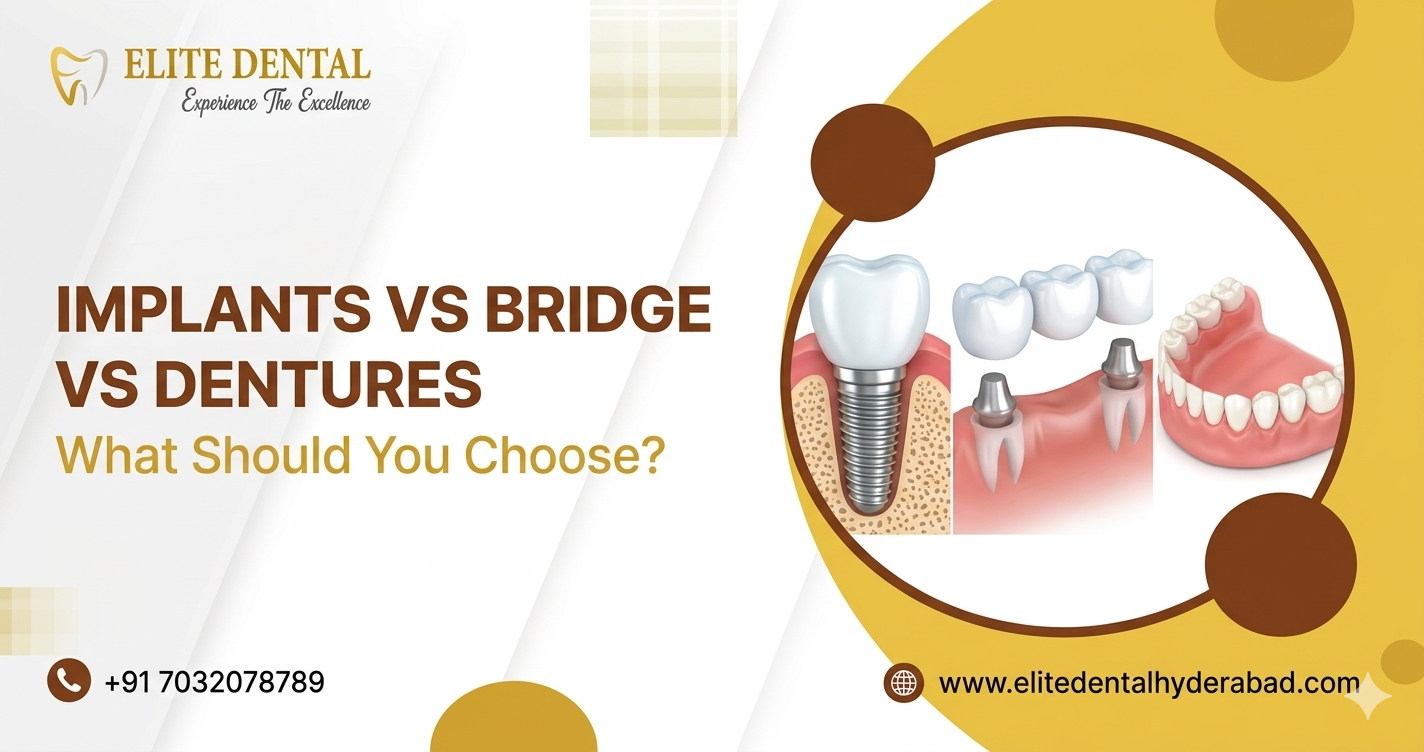
Losing a tooth can affect much more than your smile. It can change how you chew, speak, and feel about your appearance. Over time, missing teeth may also affect your bite, jawbone, and surrounding teeth. That is why replacing missing teeth is important not only for looks, but also for long-term oral health.
The three most common tooth replacement options are dental implants, dental bridges, and dentures. Each option has its own benefits, limitations, cost range, comfort level, and treatment process.
Choosing the right kids dental care in Kondapur one depends on your oral health, budget, age, lifestyle, bone condition, and personal expectations.
In this guide, we will explain each option in detail so you can make a more confident decision with your dentist.
What Are Dental Implants?
Dental implants are artificial tooth roots placed into the jawbone. They are usually made of titanium and are designed to support a crown, bridge, or denture.
A dental implant works like a natural tooth root. Once placed, it fuses with the jawbone over time. This process helps create a strong foundation for the replacement tooth.
How Dental Implants Work
Dental implants usually involve three main parts:
-
Implant post: A small screw placed into the jawbone.
-
Abutment: A connector attached to the implant.
-
Crown: The visible artificial tooth placed on top.
The final result looks and functions very much like a natural tooth.
Benefits of Dental Implants
Dental implants are often considered the most advanced tooth replacement option because they are stable, durable, and natural-looking.
1. They Look and Feel Natural
Implants are designed to blend with your natural teeth. Once the crown is placed, most people cannot easily tell the difference between an implant and a real tooth.
They also feel stable while eating and speaking because they are fixed into the jawbone.
2. They Help Protect Jawbone Health
When a tooth is missing, the jawbone in that area can slowly shrink because it no longer receives stimulation from chewing.
Dental implants help stimulate the bone, which may reduce bone loss. This is one major advantage over bridges and traditional dentures.
3. They Do Not Depend on Neighboring Teeth
Unlike bridges, implants do not require cutting or reshaping nearby healthy teeth. This helps preserve your natural tooth structure.
4. They Are Long-Lasting
With good oral hygiene and regular dental visits, implants can last many years. In many cases, they may last decades.
However, the crown attached to the implant may need replacement over time due to normal wear.
Drawbacks of Dental Implants
Although implants offer many benefits, they are not the best choice for everyone.
1. They Usually Cost More
Dental implants are often more expensive than bridges or dentures. The cost may include consultation, scans, surgery, implant placement, abutment, and crown.
If bone grafting is needed, the total cost may increase.
2. Treatment Takes Longer
Implants are not usually completed in one visit. The healing period may take several months because the implant must fuse with the jawbone.
3. Surgery Is Required
Implants involve a surgical procedure. Most patients tolerate it well, but people with certain health conditions may need extra evaluation.
Patients with uncontrolled diabetes, heavy smoking habits, gum disease, or low bone density may need additional treatment before implants are recommended.
What Is a Dental Bridge?
A dental bridge is a fixed replacement used to fill the gap left by one or more missing teeth. It is supported by natural teeth or implants on either side of the gap.
A traditional bridge usually includes one or more artificial teeth attached to crowns placed on neighboring teeth.
Benefits of Dental Bridges
Dental bridges are a popular option because they are fixed, reliable, and usually faster than implants.
1. They Restore Your Smile Quickly
A bridge can often be completed faster than an implant. Since it does not usually require jawbone healing, many patients receive their final bridge in a shorter period.
2. They Are Fixed in Place
Unlike removable dentures, bridges stay in your mouth. You do not need to remove them at night.
This makes them more comfortable and convenient for people who do not want a removable appliance.
3. They Can Be More Affordable Than Implants
A bridge may cost less than an implant, especially when replacing one tooth. However, cost depends on the materials used, number of teeth involved, and the condition of supporting teeth.
4. They Improve Chewing and Speaking
A bridge fills the empty space and helps restore bite function. It can make chewing easier and speech clearer, especially if the missing tooth is near the front of the mouth.
Drawbacks of Dental Bridges
Bridges are effective, but they also have limitations.
1. Neighboring Teeth Must Be Altered
For a traditional bridge, the teeth next to the gap are usually reshaped to support crowns. This means healthy tooth structure may need to be removed.
Once altered, these teeth will always need crowns.
2. They Do Not Stimulate the Jawbone
A bridge replaces the visible part of the missing tooth, but not the root. Because there is no artificial root in the jawbone, bone loss may still occur under the missing tooth area.
3. Cleaning Requires Extra Care
Food and plaque can collect under the bridge. You may need special floss, interdental brushes, or water flossers to clean properly.
Poor cleaning may increase the risk of gum disease or decay around supporting teeth.
4. They May Need Replacement
Bridges can last many years, but they may eventually need repair or replacement due to wear, decay, gum problems, or changes in the bite.
What Are Dentures?
Dentures are removable appliances used to replace missing teeth. They may replace a few teeth or a full arch of teeth.
There are two main types:
-
Partial dentures: Used when some natural teeth remain.
-
Complete dentures: Used when all teeth are missing in the upper or lower jaw.
Dentures can be made from acrylic, metal, flexible materials, or a combination of these.
Benefits of Dentures
Dentures are a common choice for people who need an affordable and non-surgical tooth replacement option.
1. They Are Usually More Affordable
Dentures are often less expensive than implants or bridges, especially when many teeth are missing.
This makes them a practical option for patients who need full-mouth tooth replacement on a limited budget.
2. They Can Replace Many Teeth at Once
Dentures are helpful when several teeth are missing. Complete dentures can replace an entire arch of teeth.
This makes them suitable for people who are not candidates for multiple implants or long bridges.
3. No Surgery Is Usually Needed
Traditional dentures do not require surgery. This may be helpful for patients who cannot undergo surgical treatment due to health conditions or personal preference.
4. They Improve Appearance and Basic Function
Dentures can restore facial shape, support the lips and cheeks, and improve your ability to chew compared with having no teeth.
They can also help improve speech once you adapt to them.
Drawbacks of Dentures
Dentures are useful, but they may not feel as natural or stable as implants or bridges.
1. They Can Feel Loose
Because dentures rest on the gums, they may move while eating or speaking. Lower dentures are especially more likely to feel unstable.
Denture adhesives can help, but they may not completely solve the problem.
2. They May Require Adjustment Time
New denture wearers often need time to get used to speaking, chewing, and wearing them comfortably.
Sore spots may develop at first and may require dental adjustments.
3. They Do Not Prevent Bone Loss
Like bridges, traditional dentures do not replace tooth roots. Over time, the jawbone may shrink, causing dentures to become loose.
This is why dentures often need relining, adjustment, or replacement.
4. They Need Daily Removal and Cleaning
Dentures must be removed and cleaned regularly. They should not be treated exactly like natural teeth.
Good denture hygiene is important to avoid bad breath, gum irritation, infections, and plaque buildup.
Implants vs Bridge vs Dentures: Detailed Comparison
1. Comfort
Dental Implants
Implants usually provide the most natural comfort because they are fixed into the jawbone. Once healed, they feel close to natural teeth.
Dental Bridges
Bridges are also comfortable because they are fixed in place. However, they may feel slightly different from natural teeth, especially when cleaning under them.
Dentures
Dentures may take more time to adjust to. Some people experience looseness, rubbing, or discomfort, especially in the beginning.
Best for comfort: Dental implants.
2. Durability
Dental Implants
Implants are highly durable and may last decades with proper care.
Dental Bridges
Bridges can last many years, but they may need replacement if supporting teeth weaken or develop decay.
Dentures
Dentures usually need more frequent adjustments or replacement because the gums and jawbone change over time.
Best for durability: Dental implants.
3. Cost
Dental Implants
Implants usually have the highest upfront cost. However, they may offer long-term value because they can last a long time.
Dental Bridges
Bridges are usually mid-range in cost. They may be more affordable than implants but more expensive than basic dentures.
Dentures
Dentures are usually the most budget-friendly option, especially for multiple missing teeth.
Best for lower upfront cost: Dentures.
4. Appearance
Dental Implants
Implants look very natural because each tooth is individually restored with a crown.
Dental Bridges
Bridges can also look very natural when designed well.
Dentures
Modern dentures can look attractive, but they may not always match the natural appearance of fixed teeth.
Best for natural appearance: Dental implants and bridges.
5. Maintenance
Dental Implants
Implants are brushed and flossed much like natural teeth, though regular dental checkups are essential.
Dental Bridges
Bridges require extra cleaning under the false tooth. Special flossing tools may be needed.
Dentures
Dentures must be removed, cleaned, soaked, and handled carefully every day.
Easiest maintenance: Dental implants.
Which Option Is Best for You?
There is no single best option for everyone. The right choice depends on your dental condition and personal needs.
Choose Dental Implants If:
-
You want the most natural-feeling option.
-
You have healthy gums and enough jawbone.
-
You want a long-term solution.
-
You prefer not to affect nearby healthy teeth.
-
You are comfortable with surgery and healing time.
Dental implants may be ideal for people who want a stable, long-lasting replacement and are willing to invest more upfront.
Choose a Dental Bridge If:
-
You are missing one or a few teeth.
-
The teeth next to the gap already need crowns.
-
You want a fixed option without implant surgery.
-
You want faster treatment than implants.
-
You have good supporting teeth.
A bridge may be a smart choice when neighboring teeth are strong enough or already require restoration.
Choose Dentures If:
-
You are missing many or all teeth.
-
You want a more affordable option.
-
You prefer a non-surgical solution.
-
You need a removable appliance.
-
You are not a candidate for implants or bridges.
Dentures may be suitable for patients who need functional tooth replacement at a lower cost.
What About Children and Teenagers?
Tooth replacement decisions for children and teenagers are different from adults because their jaws are still growing.
In many cases, permanent implants are not placed until jaw growth is complete. For younger patients, dentists may recommend temporary options until they are old enough for permanent treatment.
This is where early dental care and orthodontics for kids become important. If a child loses a tooth early, has spacing problems, or develops bite issues, an orthodontist can help guide proper jaw and tooth development.
Why Orthodontics for Kids Matters
Orthodontics for kids can help:
-
Monitor jaw growth.
-
Manage spacing after early tooth loss.
-
Prevent crowding and bite problems.
-
Reduce the risk of future complex dental treatment.
-
Improve long-term smile alignment.
Parents should not wait until all permanent teeth erupt if they notice crowding, missing teeth, thumb-sucking effects, jaw imbalance, or bite problems. Early evaluation can make treatment easier later.
Important Questions to Ask Your Dentist
Before choosing between implants, bridges, and dentures, ask your dentist these questions:
1. Am I a Candidate for Dental Implants?
Your dentist will check your bone level, gum health, medical history, and oral hygiene habits.
2. Will My Neighboring Teeth Be Affected?
This is especially important if you are considering a bridge. You should understand whether healthy teeth need reshaping.
3. How Long Will the Treatment Take?
Implants may take several months. Bridges and dentures may be faster.
4. What Will the Total Cost Include?
Ask whether the fee includes scans, surgery, temporary teeth, final restoration, adjustments, and follow-up visits.
5. How Long Will the Option Last?
No dental treatment lasts forever. Understanding future maintenance helps you plan better.
FAQs
1. Which is better: dental implants, bridges, or dentures?
There is no one-size-fits-all answer. Each option has its own advantages:
-
Dental implants are the most durable and natural-looking option. They are ideal if you want a long-term solution and have good bone health.
-
Dental bridges are suitable if you are missing one or a few teeth and want a fixed option without surgery.
-
Dentures are best for people missing many or all teeth and looking for a more affordable, non-surgical option.
The best choice depends on your oral health, budget, and personal preferences.
2. How long do dental implants, bridges, and dentures last?
The lifespan varies depending on care and usage:
-
Dental implants: Can last 15–25 years or even longer with proper care.
-
Dental bridges: Typically last 10–15 years.
-
Dentures: Usually need replacement or adjustment every 5–10 years.
Regular dental checkups and good oral hygiene can extend the life of any option.
3. Are dental implants painful?
Dental implant surgery is usually done under local anesthesia, so you should not feel pain during the procedure. After the surgery, mild discomfort, swelling, or soreness may occur for a few days.
Most patients report that the discomfort is manageable and less than expected. Dentists may recommend pain relief medication and proper aftercare to ensure smooth healing.
4. Are dentures uncomfortable to wear?
Dentures may feel unusual at first, especially for new users. You may experience:
-
Slight discomfort or sore spots
-
Difficulty speaking clearly at first
-
Changes in chewing ability
However, most people adjust within a few weeks. Proper fitting and follow-up adjustments can improve comfort significantly.
5. Can I eat normally with implants, bridges, or dentures?
Yes, but the experience varies:
-
Dental implants: Allow you to eat almost all types of food comfortably, including hard and chewy foods.
-
Bridges: Provide good chewing ability, though you should still be cautious with very hard foods.
-
Dentures: May require avoiding sticky or hard foods, especially in the beginning.
Over time, most patients learn to adapt their eating habits accordingly.